|
|
Affordability
Resources
There have been a lot of complaints about affordability
and inflation in the United States. With the exception of commodities
such as gasoline, diesel fuel, gas for heating, and electricity, consumers have enormous control over
prices and affordability. Marketers and sellers who want to give
you less than your money's worth hope you will not notice. This page is
provided as a public service to help consumers get a full dollar's
worth of value for every dollar spent. (Disclaimer; nothing on this
page constitutes formal engineering or financial advice.)
Extended
Warranties are Wastes of Money
Whenever you buy something in an electronics store, hardware store, or
online, the seller will push you to buy an extended warranty for your
product. These are almost universal wastes
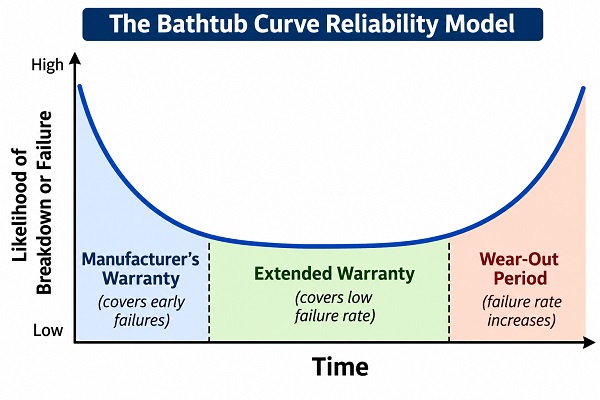
of money because, as shown by the bathtub curve reliability model,
the manufacturer's warranty covers infant mortality (due to defects in
manufacturing). The extended
warranty covers the period in which failure is least likely. The
customer is essentially throwing his or her money away while the seller
makes money without doing anything to earn it.
Financial talk show host Dave
Ramsey explains why car extended warranties are wastes of money.*
Only a small portion of what you pay in ever gets paid out. Note that
the manufacturer's warranty covers the vehicle's early life, and the
powertrain warranty tends to be more extensive.
Groceries
Google
AI reports, "National
brand-name foods cost anywhere from 20% to 100% more than store brands
(private
labels), despite blind taste tests and nutritional panels
showing identical
quality." This means you're paying a lot more, and getting nothing.
- "Organic"
often means just "same product, higher price." The
Mayo
Clinic explains, "All food in the United States must meet the same
safety standards regardless of how it's grown." However, there is less
pesticide residue than from regularly-grown food. This looks like the
only real
advantage.
- Prepared
foods, especially with fancy brand names, are higher priced. Google
AI adds, "Pre-chopped onions, cubed watermelon, and bagged stir-fry
veggies can cost double or triple the price of the whole item." Also,
expensive items are placed at the ends of aisles, and in checkout
lines, to get you to waste your money.
- Fancy
brand names and packaging raise the price of everything. This
takes advantage of the fact that
humans are motivated primarily by vision and, if something looks good,
we want
it.
Tea is generally tea, whether the generic store brand for $4 for 20
bags or tea
in fancy packaging for $10 for 20 bags.
- Don't
overpay for ice cream. Some
brands come only in one pint
quantities, with prices of $4 or more dollars a pint. Why won't the
sellers let
you buy the usual 3 pint quantities? It's
because they want you to buy their labeling and packaging rather than
actual
ice cream. Even the three pint quantities can be $1.50 a pint or
even more.
I buy a gallon of light vanilla ice cream at Target, for a little less
than a
dollar a pint. Sam's Club has a 10 pint container for less than a
dollar a
pint.
- Fancy
dog treats are a waste of money.
Their packaging and
appearance take advantage, again, of the fact that humans are
vision-motivated.
Dogs, on the other hand, smell things to determine whether they are
edible and,
if they are, the dog's agenda is to get them into his or her stomach as
rapidly
as possible. Dogs literally wolf their food down, they don't pause to
enjoy the
flavor as we do. One "upscale" dog treat made from peanut butter,
sugar (which dogs shouldn't have), and other ingredients is a lot more
expensive than straight peanut butter. (Be sure to avoid peanut butter
with
Xylitol, which is harmful to dogs.) In any event, the
marketers are selling packaging with fancy labels rather than
actual value.
- Dog
food. Fancy
packaging or brand names can also inflate the
price of dog food. Some of the "upscale" brands include, for example,
"chicken byproducts" which means the parts of the chicken that are
too disgusting for humans to eat! Also beware, though, of the really
cheap
brands that really have inferior nutrition and/or harmful ingredients.
Your
veterinarian is the best person to ask for advice.
- Warehouse
stores usually give the best value.
The price of the food is
generally lower than it is in traditional stores.
- Bottled tea and coffee are
far more expensive than loose tea, tea bags, and ground coffee.
A major reason is that it costs money to ship volume and weight, and
water (the primary components of bottled drinks) weighs a lot, takes up
a lot of room, and costs maybe a couple of cents a gallon out of the
tap. Soft drinks have the same issue, but I have seen only one
self-carbonating drink powder that looks like it is worth the money.
- Convenience
stores are high-priced. Buying
food in a
convenience store is like buying it in a restaurant; something you
might do
while traveling, but not a good way to stock your refrigerator.
Automobiles
Financial talk show host Dave Ramsey talks about the
problems with things with wheels and motors. They lose a lot of their
value the instant you drive them, if new, off the dealer's lot. I have
a 2004 Mercury Grand Marquis. It's a pleasure to drive, the power
trains in those vehicles last almost forever, and it gets me where I
need to go. I could afford a new car, but why should I take the money
out of my investments when the one I have works?
* If you buy a car that is a year or two old, it
costs a lot less because it is used, but it still has most of its life
left in it.
* Car dealers often try to pack a lot of
non-value-adding trash into the sale price such as "environmental
treatments" (hundreds of dollars to spray the upholstery with fabric
protectant), "advertising fees," and other junk fees. When you get the
invoice, just cross these items off and say "Don't want it."
* Car dealers often focus on payments rather than
the actual price, and they make a lot of money on financing. My own
inclination would be to act as if I intended to finance the car to get
a lower sale price, and then walk in with a cashier's check for that
amount on the day of the actual sale.
* Dave Ramsey refers to car leases as "fleeces," and
with good reason.
* An Internet search on "How car dealers rip you
off" is highly instructive. Google AI comes up with "Dealers
automatically add expensive items like VIN etching, gap insurance, or
paint protection, claiming they are mandatory." Just cross them off the
invoice without even asking the dealer's permission and say "Don't want
it." More at https://financebuzz.com/car-dealership-rip-offs
Health Care
and Insurance
- Health insurance.
My experience with ACA plans is that even the Bronze plans are
expensive, with high deductibles. The Silver and Gold plans are even
more expensive, and have high deductibles. You can circumvent the ACA
insurers with health sharing ministries. One drawback is that they
don't cover preexisting conditions, and they have lifetime limits ($1
to $2 million for the better plans). You also can't smoke, but
shouldn't do that anyway. They are, however, much less expensive and
feature some of the price controls characteristic of Medicare and
regular health insurance. See if a health cost sharing ministry is
right for you.
- Medical Tests and
Diagnostics. Beware of hospital labs' "facility fees" that
increase the cost of blood testing and diagnostic imaging enormously.
Independent blood testing and imaging labs don't have these fees, and
also tell you up front what your procedure will cost. Your cost may actually be lower if you
don't use insurance.
- Medications. There
is a lot of controversy about pharmacy benefit managers (PBMs) which
raise costs for patients and sometimes reimburse the pharmacist so
little that the pharmacist loses money. A supply chain entity that adds
costs but no value is no longer a partner but a parasite. Henry Ford
wrote long ago that everybody and everything must produce or get out,
so why some PBMs are tolerated is beyond me.
- In some cases, the
insurance covered price is MORE than the price without insurance.
I recently forgot this, and ended up paying $5 more for a prescription
with insurance than without it! Ask
the pharmacist the out of pocket cost with and without insurance.
- From Google AI, "Bypassing pharmacy benefit managers
(PBMs) can be achieved by consumers, employers, and drug manufacturers
by shifting away from traditional insurance routing and utilizing
direct-to-consumer digital pharmacies, direct-to-employer contracts, or
newly launched federal direct-purchase programs."
- Challenge marked-up
medications in hospitals. From Google AI, "To avoid paying
hyper-inflated prices for over-the-counter medications like a $5
aspirin in a hospital, your most effective strategy is to request a
fully itemized bill and explicitly contest the routine medication
charges. Hospitals use an internal list called a "Charge Master" to set
inflated baseline prices for minor items, factoring in the cost of the
pharmacy supply chain, safety reviews, and nursing delivery. However,
these prices are highly negotiable.
Clothing
Upscale clothing companies have a real racket in which they use fancy
designer labels to put made-in-America prices on made-in-China
products. They take something you might buy in a warehouse store for
$20, put a designer label on it, and mark it up to $100. This is why we
see handbags that cost thousands of dollars, and athletic shoes that
cost maybe $20 to make with $200 price tags if they put a famous
athlete's name on them.
- In some cases, an expensive item is just marked "imported."
If it was imported from a high wage country like Italy or France, it
would say so. "Imported" means from Mainland China or some other
low-wage country.
- I remember going into a store at the Wyoming Valley Mall
because I needed a belt, and a $50 or $60 one was labeled "Made in
Vietnam." I got one on Amazon for less than $30 and, although it was
made in China, at least I paid a made-in-China price and not a
made-in-America price.
* Does not imply Dave Ramsey's endorsement of this web site; we
recommend his show, and Clark Howard's, as having good information.
Contact Us
Levinson Productivity Systems P.C.
6 Lexington Court
Wilkes-Barre PA 18702
570-824-1986
TheBoss "at" ct-yankee.com
|